The First Hour After a Crash Decides Everything — Here’s How Not to Blow It
Picture this: you’re sitting at a red light, watching it turn green, and you ease into the intersection. Then impact. The other driver ran their red. Your airbags didn’t deploy, but your hands are shaking, your neck already feels stiff, and the other driver is out of their car looking at you like you did something wrong.
You know you didn’t cause this. But knowing it and proving it are two different things — and the gap between them closes fast in that first hour.
I spent years on the other side of this equation, adjusting bodily injury claims for an insurance company. I watched how quickly a clean liability picture could get muddied when the not-at-fault driver didn’t document the scene, delayed medical care, or said something offhand to a claims rep that got logged in the file. Now I work with injured drivers, and I write pieces like this one because the same gaps keep surfacing in online forums and waiting rooms. People who were clearly not at fault, losing ground because nobody told them what to do in the first sixty minutes.
Here’s what actually matters.
The Moment Right After Impact
Most people’s instinct is to get out of the car and start talking. Don’t.
Check yourself and every passenger before you open the door. Adrenaline is a powerful painkiller — you may feel fine and have a cervical strain that won’t announce itself for another twelve hours. Note how your body feels right now. That observation matters later. If anyone is injured or vehicles are blocking traffic, call 911 immediately. If the crash is minor and everyone is ambulatory, move vehicles to a safe position only if doing so doesn’t disturb physical evidence before you’ve photographed it.
Turn on your hazard lights. Stay aware of traffic. And then, before you say a single word to the other driver, take a breath and reach for your phone.
Building Your Evidence: The Priority Stack
This is where the claim gets won or lost. Most people spend about four minutes on documentation when they should spend twenty. Here’s what to capture, in order of urgency:
| Priority | Evidence Type | Why It Expires |
|---|---|---|
| 1 | Other driver’s license plate | They may leave the scene |
| 2 | Photos of both vehicles | Cars get moved within minutes |
| 3 | Witness names and numbers | Bystanders drift away fast |
| 4 | Traffic signal / stop sign | Context disappears in memory |
| 5 | Nearby surveillance cameras | Footage gets overwritten in 24–72 hours |
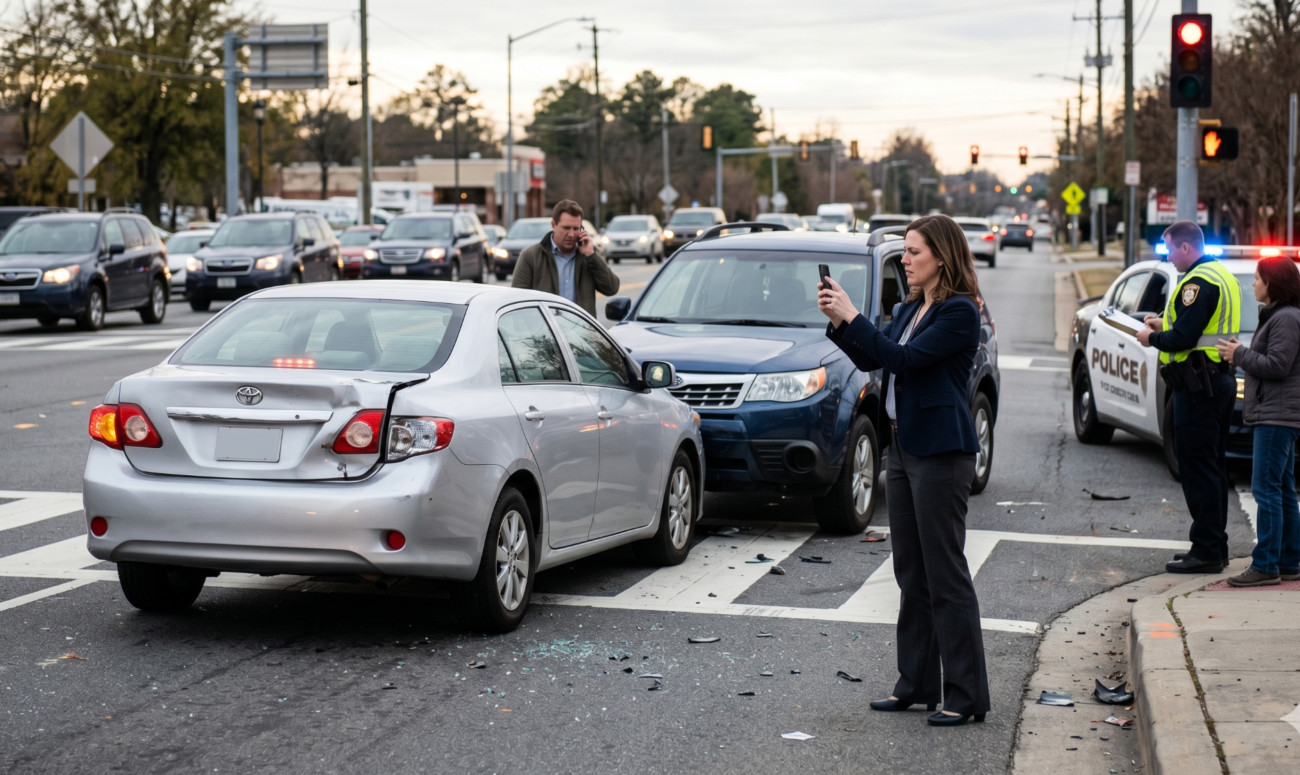
On photos and video: Walk the entire scene before anything moves. Photograph both vehicles from multiple angles — wide shots showing the full scene, then close-ups of every point of contact, every skid mark, every piece of debris. Capture road conditions, any obstructions, and the surrounding intersection layout.
Video is underused. Walk around both vehicles narrating what you see: “This is the front of my vehicle — the damage begins at the driver’s side headlight and extends across the hood.” That audio timestamp and visual record is harder to dispute than a written description filed days later.
On witnesses: Look around immediately. Bystanders who saw the crash will drift away within minutes. Ask directly: “Did you see the accident? Would you be willing to give me your name and number?” Most people will. Get their full name, phone number, and a brief verbal account — even a voice memo works. An independent witness who corroborates your version of events can neutralize a disputed liability file almost entirely.
On the contact exchange: Collect the other driver’s full name, home address, phone number, driver’s license number, license plate, vehicle make and model, and their insurance company name and policy number. Don’t accept a business card as a substitute for a policy card. Photograph both their license and their insurance card directly. If the registered owner differs from the driver, you need both people’s information.
What if the other driver leaves? California’s official guidance on hit-and-run situations advises leaving a note with the names and addresses of all involved drivers and owners — a concrete step that preserves your legal standing when the other party flees. Photograph the note before you leave it.
Calling the Police: When, Why, and What If They Don’t Come
Call. Almost always.
A police report is an independent third-party record created at the scene. It documents road conditions, driver statements, witness information, and — in many cases — the officer’s preliminary assessment of fault. Insurance adjusters weight police reports heavily. A file with a police report is a fundamentally different conversation than a file without one.
State guidance makes clear that officers may not respond to every scene, particularly minor collisions on private property. If dispatch tells you no unit is coming, that’s not permission to skip documentation. Ask whether you can file a report at the station or online — many jurisdictions allow self-reporting for property-damage-only crashes. Do it the same day.
When officers do arrive, be factual and direct. Describe what happened in sequence: where you were, what the signal showed, what you observed before impact. Don’t speculate about the other driver’s intent. Don’t minimize your symptoms — if your neck feels stiff, say so. Officers note reported injuries in their reports, and that notation matters when medical records surface weeks later.
The Injury Question: Why “I Feel Fine” Is the Most Expensive Thing You Can Say
Soft tissue injuries — whiplash, muscle strain, ligament damage — routinely don’t peak until 24 to 72 hours after impact.
The adrenaline response at the scene suppresses pain signals. I’ve seen clients who walked away from crashes feeling shaken but functional, woke up the next morning unable to turn their heads, and then faced an adjuster who noted “no injuries reported at scene” as a reason to discount the claim. The logic adjusters use is blunt: “If you were really hurt, you would have sought care immediately.” It’s not always fair reasoning, but it’s the reasoning that gets applied.
If you have any physical symptoms at the scene — stiffness, headache, dizziness, chest tightness, even just feeling “off” — tell the responding officer. Tell your own insurance company when you notify them. Go to a doctor or urgent care that day, or the next morning at the absolute latest. Not because you’re gaming the system, but because you need to know what happened to your body, and because the medical record created closest to the crash date is the most credible one.
Delayed treatment creates a gap. Protect yourself by getting evaluated early.
Reporting to Your Insurance — and Handling Theirs
These are two very different conversations.
Your insurer: The California Department of Insurance advises notifying your own agent and insurance company immediately after a crash and keeping copies of all accident documents. Notify your own insurer the same day, even if the other driver was clearly at fault. Your policy likely requires prompt notice, and your insurer can help protect your interests in a disputed liability situation.
Their insurer: The other driver’s insurance company will call you. They will be polite. They may ask for a recorded statement “just to get your side of things.” You are under no obligation to give one.
Their job is to resolve the claim for as little as possible. A recorded statement taken before you’ve seen a doctor, before the police report is finalized, and before you understand the full extent of your damages is almost never in your interest. You can tell them: “I’m still gathering information and haven’t completed medical evaluation. I’ll be in touch once I have a complete picture.” That’s not evasive — that’s accurate.
If the crash involved significant injuries, disputed liability, or any complexity at all, speaking with a personal injury lawyer boston before giving any recorded statement is worth a phone call. Most personal injury attorneys offer free consultations, and one conversation can clarify what you’re entitled to and what you should avoid saying.
Your Step-by-Step Sequence
To make this concrete — here’s the full priority order, from impact to the days that follow:
- Safety and medical triage — check yourself and passengers; call 911 if anyone is hurt
- Photograph everything before vehicles move — both cars, all damage, the road, signals, debris, nearby cameras
- Collect witness information immediately, before bystanders leave
- Exchange full contact and insurance details with the other driver
- Call police or confirm how to file a report if they won’t respond
- Notify your own insurance company the same day
- Seek medical evaluation within 24 hours, even if symptoms seem minor
One deadline worth knowing: California’s DMV requires you or your representative to complete an SR-1 form and submit it within 10 days if anyone is injured or killed, or if property damage exceeds $1,000 — and this SR-1 is required in addition to any report made to the police, CHP, or your insurance company. Failure to file can result in license suspension regardless of fault. (California DMV — Accident Reporting)
The Questions People Are Afraid to Ask
What if I didn’t get photos because I was too shaken? Work with what you have. Return to the scene if possible — road markings, signal positions, and intersection geometry don’t change overnight. Request the police report as soon as it’s available. Check whether nearby businesses have surveillance footage and send a written preservation request within 48 hours.
What if the other driver’s story contradicts mine? This is exactly why the police report, witness statements, and physical evidence matter. Contradicting accounts are common. The file that wins is the one with more corroboration, not necessarily the one with the most confident narrator.
What if I said something at the scene I regret? Statements made in the immediate aftermath — “I didn’t even see you” or “I’m so sorry” — are less damaging than people fear when physical evidence clearly supports your account. Document what you actually observed and let the evidence carry the weight.
The crash wasn’t your fault. What happens next is largely within your control — and now you know what to do with it.